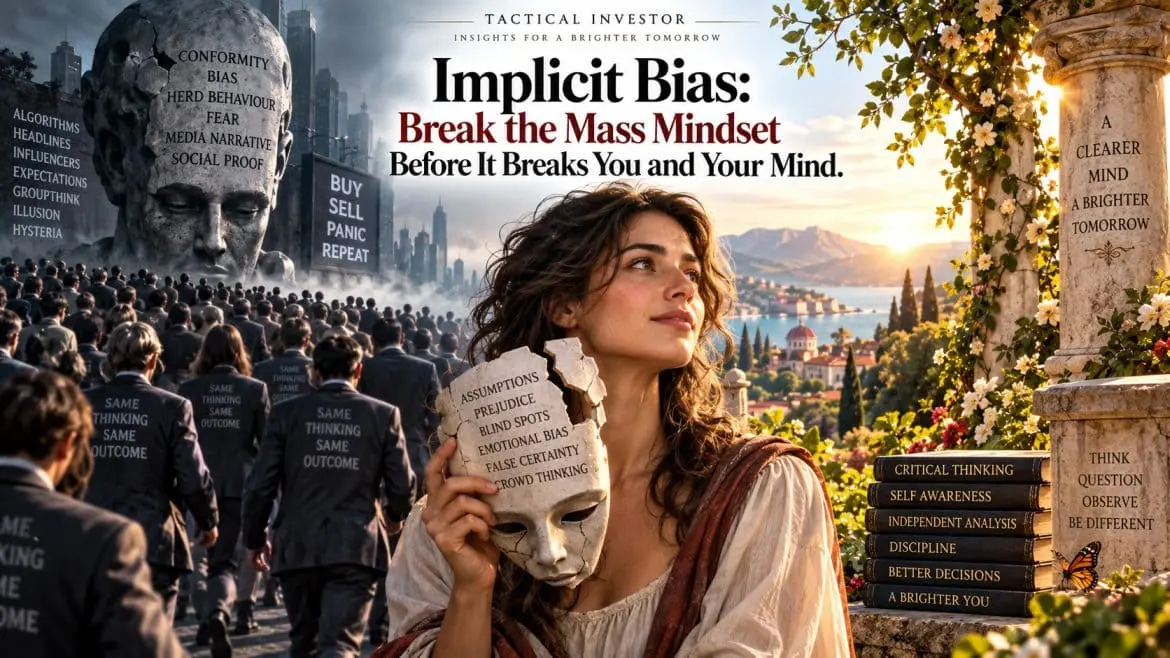
Implicit Bias: Escape the Mass Mindset Before It Costs You
September 15, 2026
Implicit bias operates beneath conscious thought, quietly influencing how we interpret information, assess risk and respond to events before we have even realized that a decision has been made. In financial markets, this becomes particularly dangerous because the bias inside your own mind is constantly being reinforced by the behaviour of everyone around you, meaning that what feels like independent judgement can actually be the echo of a much larger psychological force.
You may believe you are making a rational decision because you have studied the company, read the news and examined the chart, but if your emotional response is identical to that of everyone else, you may simply be participating in the mass mindset while convincing yourself that you are thinking independently. The market is full of investors who believe they are acting on information when they are actually reacting to the emotional interpretation of that information.
The first step toward escaping this trap is recognizing an uncomfortable possibility: your strongest conviction may sometimes be evidence that the crowd has already taken control of your thinking.
Implicit Bias Is the Invisible Hand Inside Your Own Head
Implicit bias refers to unconscious associations and mental shortcuts that influence judgement without requiring deliberate intent. These shortcuts are not automatically harmful because the brain needs them to process enormous amounts of information, but they become dangerous when they cause you to respond emotionally to a market situation without recognizing the psychological mechanism driving the response.
This is where human psychology becomes inseparable from investing. Your brain does not evaluate every market event from a position of perfect neutrality, because recent experiences, previous losses, social pressure, personal beliefs and the behaviour of other investors all influence what appears attractive or dangerous. The market therefore does not merely test your financial knowledge. It tests whether you can recognize when your own mind has become part of the crowd.
The Crowd Can Make a Bad Decision Feel Perfectly Rational
Consider what happens during a severe market decline. Prices are falling, financial headlines are becoming increasingly negative, analysts are lowering forecasts, social media is filled with warnings, and people around you are discussing whether the entire market is about to collapse.
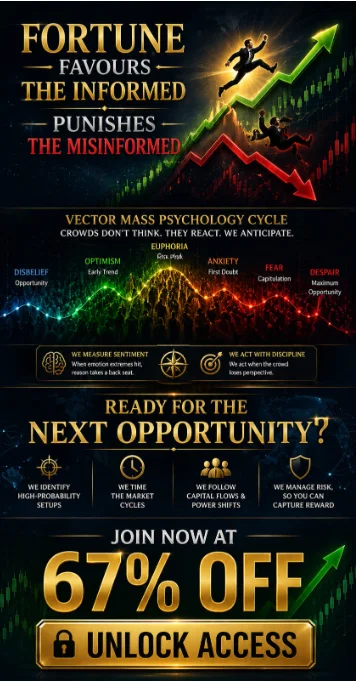
You feel fear. That fear feels like information. Then everyone else starts expressing the same fear, and suddenly your emotional reaction appears to have been validated by the entire market. This is where implicit bias becomes dangerous because the fact that everyone agrees with you does not necessarily mean your conclusion is correct. It may simply mean that the same emotional force has reached thousands of people simultaneously, creating a form of collective confirmation in which fear validates fear. That is mass psychology in action.
The Most Valuable Signal Can Be the Emotion You Want to Obey
One of the most powerful ways to expose implicit bias is to examine what you instinctively want to do. When the market is crashing and you desperately want to sell, ask why. When a stock has already risen dramatically and you feel that buying now is the only way to avoid missing out, ask why. Your emotional reaction is not automatically wrong, but when that reaction becomes synchronized with the crowd and is supported by extreme sentiment, it deserves much greater scrutiny.
This creates a powerful contrarian principle: when your emotions are screaming one thing and the psychological evidence confirms that the crowd is doing exactly the same thing, investigate the opposite possibility.
That does not mean blindly doing the opposite.It means becoming curious about why the emotion has become so powerful. If you are terrified to buy and everyone else is terrified to buy, the conditions may be developing for an opportunity. If you feel that it is already too late to buy because everyone is becoming euphoric and you are terrified of missing the next leg higher, the conditions may be developing for profit-taking. The emotion becomes the starting point for investigation rather than the command you automatically obey.
Fear Can Become Your Greatest Enemy, and Your Greatest Signal
Fear is one of the most powerful forces in financial markets because it changes behaviour faster than fundamentals can change. Investors who were comfortable owning a company at $100 can suddenly become desperate to sell it at $70, not necessarily because the business has deteriorated by 30%, but because the psychological pain associated with watching the price fall has become unbearable.
This is where the prepared investor begins looking for deviations. If the market is falling sharply, negative sentiment is becoming extreme and fundamentally different assets are being liquidated indiscriminately, you should not automatically buy. You should study whether the emotional damage is becoming disproportionate to the fundamental damage, whether selling pressure is accelerating or losing effectiveness, and whether the market is beginning to show divergences between price, momentum, breadth and sentiment.
The opportunity is not created simply because prices are lower. It is created when fear has pushed prices further away from reasonable value than the underlying reality justifies. This is what separates disciplined contrarian investing from reckless bottom-fishing.
Do Not Jump Into the First Wave of Selling
One of the greatest mistakes a contrarian investor can make is becoming so determined to oppose the crowd that they jump in front of a moving train. A market can remain extremely oversold and continue falling. The first wave of selling is often not the end of the process, and during serious declines you may see multiple waves as investors who initially held on eventually capitulate, institutions reduce exposure, margin pressure forces liquidation and negative sentiment continues feeding upon itself.
This is why patience matters. If negative sentiment is extremely high and the market is pulling back sharply, you do not simply throw money into the first decline because you have decided that everyone else is wrong. You watch the subsequent waves, study whether selling pressure is intensifying or exhausting itself, and wait for evidence that the market is beginning to absorb the supply rather than simply accelerating lower. You are not trying to catch the exact bottom because nobody can consistently do that. You are trying to recognize when the risk/reward equation has materially changed.
The Vector Tells You Whether Emotion Is Strengthening or Failing
This is where vector psychology becomes practical rather than theoretical. A market vector represents the direction, intensity, breadth and persistence of the forces moving capital. During a decline, the important question is not simply whether the market is down, but whether the negative force is becoming stronger, broader and more persistent, or whether it is beginning to lose its ability to push prices lower.
A powerful bearish vector may be characterized by expanding selling, deteriorating breadth, rising volatility, worsening sentiment and persistent failures of support. But when fear remains extreme while selling becomes less effective, breadth begins stabilizing and momentum starts diverging from price, the market may be telling you that the force driving the decline is beginning to exhaust itself. That is not a guaranteed bottom. It is a change in the evidence and that is what matters.
Euphoria Creates the Same Trap in Reverse
Implicit bias does not only destroy investors during crashes. It can become equally dangerous during powerful rallies because rising prices create their own psychological feedback loop.
A stock rises, investors become confident, confidence attracts more buyers, rising prices validate the original decision, the financial media creates a stronger narrative, and eventually investors begin believing that refusing to buy is itself a mistake.
This is where FOMO becomes particularly powerful because the investor is no longer evaluating value. They are evaluating the pain of being left behind. The emotional statement changes from “This is too expensive” to “I cannot afford to miss this.” That transition matters.
When you feel that you are already late, when everyone around you is convinced the market can only go higher and when the emotional pressure to participate becomes overwhelming, the correct response is not automatically to sell everything. It is to examine whether euphoria has become excessive, whether valuation has outrun fundamentals, whether breadth is weakening and whether the market is showing signs that the bullish force is becoming saturated. You may still miss another 10%, 20% or even more upside but that is part of the game.
You Will Never Sell the Exact Top
A disciplined investor must accept that taking profits early can feel frustrating when the market continues rising. You may sell a stock at $100 only to watch it reach $120, and the temptation will be to conclude that you made a mistake because hindsight makes the higher price seem inevitable.
That is another form of bias. Your objective is not to sell at the highest possible price. Your objective is to recognize when the emotional environment has become sufficiently euphoric that the risk/reward equation is no longer as attractive as it was before, then take some profits and accept that the market may continue moving without you.
Nothing works exactly as planned. The stock may fall immediately, or it may rise another 30% after you sell. You cannot control that. What you can control is whether you repeatedly allow greed to turn a profitable position into a round trip because you became emotionally attached to being right about the next move.
Cash-Secured Puts Turn Extreme Fear Into an Opportunity
The same psychological distortions that create unusually low stock prices can also affect options. When fear becomes intense, investors often pay substantial premiums for protection, volatility rises and option pricing can become temporarily disconnected from the longer-term economics of the underlying company.
This is where cash-secured puts can become particularly useful for an investor who genuinely wants to own the stock. Instead of chasing a falling stock, you can establish a price at which you would be happy to buy it and sell a cash-secured put against that position, collecting the premium while waiting. If the stock remains above the strike, you keep the premium, while assignment allows you to acquire the shares at the strike less the premium received.
In exceptional situations, the effective discount can become very substantial, potentially approaching 30%, although that should never be treated as the expected outcome. Anything above roughly 18% should be regarded as a bonus, because the real objective is to find a good company at an attractive price while the crowd’s fear has simultaneously inflated option premiums.
The ideal setup is therefore not simply high premium. It is high fear + good company + attractive valuation + distorted option pricing. That combination is where getting paid to wait becomes particularly powerful.
The Best Contrarian Trade Often Feels Wrong
The uncomfortable truth about contrarian investing is that the best opportunities rarely feel comfortable when they first appear. If everyone already agrees that an asset is cheap, the opportunity may already be widely recognized, while the truly interesting situations tend to appear when buying feels emotionally irresponsible.
That does not mean discomfort proves an investment is good. It means discomfort deserves investigation. When fear is high, sentiment is deeply negative and the market begins displaying divergences suggesting that the selling force is losing effectiveness, the emotional resistance to buying can itself become part of the opportunity. Conversely, when euphoria is extreme and the emotional resistance to buying has almost disappeared, the absence of fear can become a warning that risk has been forgotten. This is why the investor must learn to study emotion without becoming controlled by it.
Mass Psychology Becomes Your Early Warning System
The crowd does not reliably predict the future, but it can provide an early warning because collective behaviour often changes before the consequences become fully visible. When investors become excessively optimistic, risk is gradually dismissed. When they become excessively fearful, assets can be liquidated indiscriminately. When the emotional response becomes extreme, price can begin deviating from fundamental reality, creating the conditions in which the next major opportunity or danger starts taking shape.
The crowd therefore becomes a form of market intelligence, not because it is usually right, because it reveals where emotional pressure is building. Study what people believe, but study what they do even more carefully. Watch whether fear is spreading, whether confidence is becoming certainty, whether investors are abandoning fundamentally different assets indiscriminately, whether volatility is expanding, whether breadth is deteriorating, and whether price continues responding to increasingly extreme information in the same direction. Then look for the divergence.
Escape the Bias by Studying Yourself Through the Crowd
The objective is not to become emotionless because that is neither realistic nor necessary. Fear and greed are part of being human, and attempting to suppress them completely can simply drive them underground where they become harder to recognize.
The objective is to become aware of them. When you feel terrified to buy, investigate whether the crowd is equally terrified and whether the market evidence supports the possibility that fear has become excessive. When you feel desperate to buy because you believe the market is about to explode higher, investigate whether euphoria has already become widespread and whether you are reacting to opportunity or simply reacting to the fear of missing out.
This creates a simple discipline: Study the emotion. Study the crowd. Study the price. Study the divergence. Then study the vector.
You are not trying to predict the exact top or bottom because that is a game the market is designed to make almost impossible. You are looking for the moments when emotional behaviour becomes extreme enough to create a deviation between price and reality, and those moments can provide the asymmetric opportunities that ordinary market participation rarely offers.
The Mindset That Wins Is Not Prediction. It Is Recognition.
Implicit bias becomes dangerous when it convinces you that your emotional reaction is objective analysis. The crowd becomes dangerous when millions of investors reinforce that reaction until fear looks like certainty and euphoria looks like intelligence.
The antidote is not to become permanently bearish, permanently bullish or mechanically contrarian. The antidote is to become observant enough to recognize when your emotions are moving in perfect synchronisation with the crowd, then use sentiment, price behaviour, valuation, breadth, momentum and the market vector to determine whether that emotional consensus is creating opportunity or confirming genuine deterioration.
You will not buy every bottom and you will not sell every top. You will miss some opportunities, and you will occasionally sell too early only to watch a stock continue higher. That is acceptable. The objective is to win over the long term by repeatedly making better decisions when the crowd becomes emotionally extreme. When fear is overwhelming and the evidence shows that the selling force is beginning to exhaust itself, you look for opportunity without pretending you have found the exact bottom; when euphoria becomes overwhelming and everyone believes the market can only rise, you protect profits without pretending you have found the exact top.
The crowd wants certainty but the disciplined investor wants evidence. And once you understand that distinction, implicit bias stops being merely a psychological weakness and becomes something far more useful: a warning system telling you when your own emotions may be following the crowd too closely.